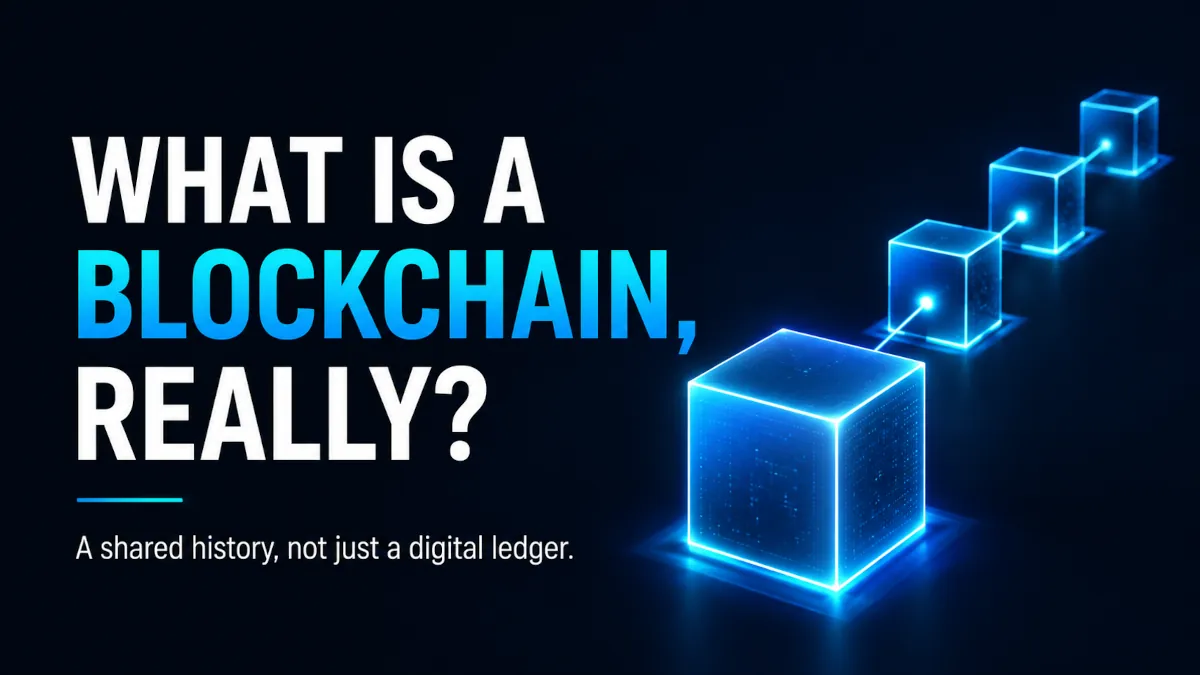
People often describe blockchain as a “digital ledger.”
That is true.
It is also not very helpful. A spreadsheet is a digital ledger too. So what makes a blockchain different?
The answer is not the blocks.
It is the way many computers can agree on the same history without one company controlling it.
Imagine a Public Notebook
Imagine a notebook sitting in the middle of a town square. Anyone can read it. People use it to record transactions.
- Alice paid Bob.
- Bob paid Charlie.
- Charlie paid Dana.
But there is a problem. Who gets to write in the notebook?
And what stops someone from erasing a page and writing a new version?
A blockchain solves this by giving many computers their own copy.
These computers are called nodes.
Instead of trusting one master notebook, the network compares copies and follows shared rules.
Why the “Blocks”?
Transactions do not usually enter the blockchain one by one. They are grouped together.
Each group is called a block.
Think of a block as a page in our notebook. When a new page is accepted, it is connected to the page before it. Then another page is added. And another.
That creates the chain.
Hence the name: blockchain.
What Connects the Blocks?
Each block contains a kind of digital fingerprint of the previous block.
This fingerprint is produced using a cryptographic hash.
A hash turns data into a short, fixed-length value. Change even a tiny part of the original data and the hash changes dramatically. That creates an interesting effect.
Suppose someone changes an old transaction. The fingerprint of that block changes. Now the next block points to the wrong fingerprint. And so does everything after it.
The alteration becomes obvious. It is like changing page 30 of a book when page 31 contains a sealed summary of exactly what page 30 looked like.
But Who Decides Which Block Is Real?
This is the harder part.
Thousands of computers may be participating. They need a way to agree on which new block should be accepted.
That process is called consensus.
Bitcoin uses Proof of Work. Ethereum uses Proof of Stake. Other blockchains use different systems. The mechanisms vary. The goal is the same.
Get many independent computers to agree on one valid history.
No single participant should be able to rewrite that history whenever they want.
Is a Blockchain Impossible to Change?
No.
That is a common exaggeration. Blockchains are not magically immutable. They are designed to make rewriting confirmed history very difficult, expensive, or unlikely. The exact level of security depends on the network.
A large decentralized blockchain can be extremely hard to manipulate. A small poorly secured one may not be. So the important word is not “unchangeable.” It is tamper-resistant.
Why Not Just Use a Normal Database?
Often, you should. Normal databases are faster. They are simpler. They are cheaper to operate. If one trusted organization controls the system, a blockchain may add little value.
Blockchain becomes interesting when several parties need to share a record but do not want one party to have complete control over it.
That is the problem it was built to solve.
The Point
A blockchain is not just a chain of digital blocks. It is a way to maintain a shared history between computers that may not trust each other.
Cryptography links the records. Consensus decides what gets added.
Thousands of copies make hidden changes difficult. And that shared history is what allows cryptocurrencies to work without a central bank keeping the master record.
So the real innovation is not the block.
It is the agreement.

Comments 0
Log in to join the conversation.
Log inStart the conversation.