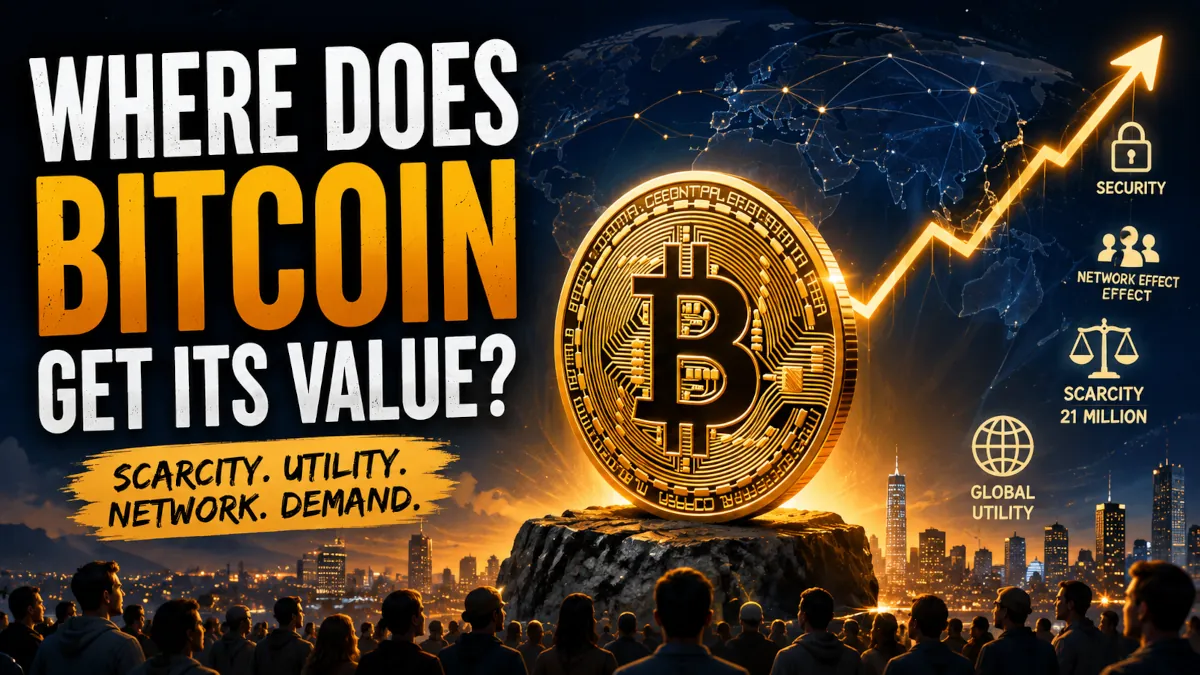
Bitcoin is not backed by gold. It is not issued by a government, and you cannot eat it, build with it, or turn it into fuel. So why is one Bitcoin worth anything at all?
The answer starts with a simple idea: value does not have to come from the object itself.
A Piece of Paper Can Be Worth $100
Imagine finding two pieces of paper on the ground. One is blank, while the other is a $100 bill.
Physically, they are not very different. The paper itself is worth almost nothing. What matters is that people agree the second piece of paper has value. Shops accept it, banks recognize it, and other people are willing to exchange goods and services for it.
Money works partly because people expect other people to accept it too. Bitcoin takes that basic idea and removes the paper.
Scarcity Matters
One of Bitcoin's most famous features is its limited supply. Under its current rules, there will never be more than 21 million BTC.
Scarcity alone does not create value. Plenty of rare things are worthless. But scarcity becomes important when something is also useful or desirable.
Gold is valuable partly because it is difficult to obtain and its supply cannot suddenly double overnight. Bitcoin creates a similar kind of scarcity through code. No central bank can simply decide to create another 50 million BTC.
That predictable supply is one of the reasons some people find it attractive.
But Why Would Anyone Want It?
Bitcoin can be transferred across the internet without asking a bank to approve the transaction. It can be held directly by its owner, sent across borders, and verified using a public network whose rules are known in advance.
For some people, those properties are useful in themselves. Others mainly see Bitcoin as an investment or a possible store of value. Often, the two ideas overlap.
And this creates a familiar economic situation. If more people want an asset while its supply remains limited, buyers may become willing to pay more for it.
The Network Matters Too
Imagine a social network with ten users. Even if the software is brilliant, it is not very useful.
Now imagine the same network with 500 million users. Suddenly it becomes much more valuable because everyone else is already there.
Bitcoin benefits from a similar effect. Its value does not come only from its code. Around it exists an enormous ecosystem of miners, nodes, exchanges, developers, wallets, businesses, investors, and users.
Anyone can copy Bitcoin's software and create another cryptocurrency. What they cannot instantly copy is Bitcoin's history, liquidity, security, recognition, infrastructure, and existing network of participants.
That difference matters.
Does Bitcoin Have a “True” Price?
Not really.
There is no hidden formula inside Bitcoin that says one BTC should be worth $20,000, $100,000, or any other number. Its market price is simply the price at which buyers and sellers are willing to trade at a given moment.
If demand increases, the price can rise. If people lose confidence or interest, it can fall. Sometimes very quickly.
This is why Bitcoin can have significant value while still being extremely volatile.
The Point
Bitcoin gets its value from a combination of scarcity, usefulness, security, network effects, and demand.
It is not valuable simply because only 21 million can exist. And it is not valuable purely because people collectively decided to pretend that it is.
People value certain properties of the Bitcoin network. The market then decides how much those properties—and access to a scarce asset within that network—are worth.
In that sense, Bitcoin's value is not as mysterious as it first appears.
The more interesting next question is this:
If anyone can create another cryptocurrency, why did Bitcoin become the one that mattered?

Comments 0
Log in to join the conversation.
Log inStart the conversation.