

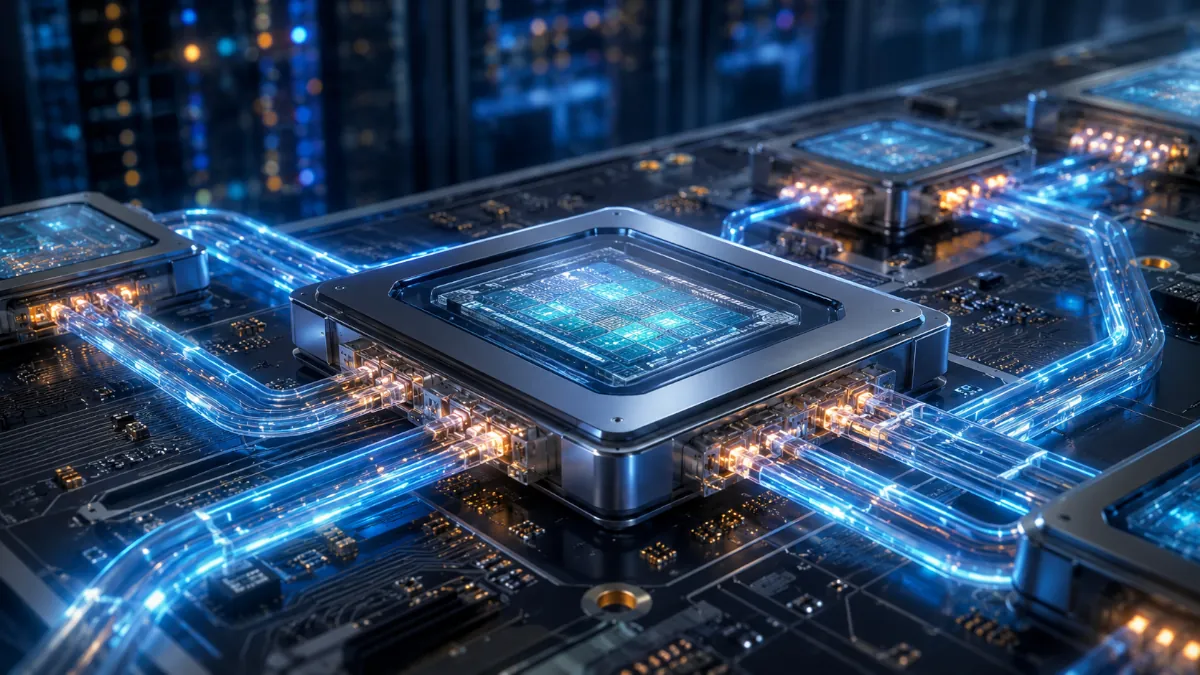
Modern AI chips can perform an astonishing number of calculations every second.
But there is another problem becoming increasingly difficult to solve:
How do you move all that data between the chips fast enough?
Inside computers, information has traditionally travelled as electrical signals through copper connections. That works extremely well over short distances. But as AI systems grow into clusters containing thousands of accelerators, moving huge amounts of data starts consuming significant energy and physical space.
At some point, making the processors faster isn't enough.
The connections between them become the bottleneck.
And one possible solution is surprisingly simple:
Use light.
From electrons to photons
The idea isn't new. The internet already relies heavily on fibre-optic cables, where information travels as pulses of light.
What is changing is how close that optical technology can get to the processors themselves.
Instead of sending electrical signals relatively long distances before converting them into light, engineers are developing silicon photonics — tiny optical components manufactured using technologies related to those used for conventional computer chips.
These devices can contain microscopic waveguides, modulators and photodetectors that manipulate light directly on or beside silicon chips.
Think of them as miniature optical highways built into the computer.
Why light?
Electrical connections have several limitations.
As data rates increase, electrical signals lose energy, generate heat and become increasingly difficult to transmit efficiently over longer connections.
Photons behave differently. Light can move enormous amounts of information with comparatively low transmission loss. Multiple wavelengths of light can even travel through the same optical path simultaneously, allowing several streams of data to share one connection.
This is one reason optical communication has already conquered long-distance networking.
Engineers want to bring some of those advantages inside the machines doing the computation.
Optics is moving closer to the chip
One important concept is called co-packaged optics.
Instead of placing optical transceivers farther away at the edge of a server or network switch, optical components can be positioned directly beside the processing or switching hardware.
That reduces the distance high-speed electrical signals need to travel before being converted into light.
Researchers are pushing this idea even further.
In 2025, a team reported a three-dimensional electronic-photonic platform containing 80 optical transmitters and receivers in only 0.3 square millimetres of chip area.
The system demonstrated an aggregate bandwidth of 800 gigabits per second, while its transmitter and receiver front ends operated with extremely low energy per communicated bit.
That is the kind of density future AI hardware may need.
Does this mean computers will calculate with light?
Not necessarily.
There is a difference between photonic computing and photonic communication.
Researchers are experimenting with systems that actually perform mathematical operations using light, but conventional electronic processors remain extraordinarily powerful and flexible.
The more immediate transformation may happen in communication.
GPUs and other accelerators could continue performing calculations electronically while photons increasingly carry information between them.
So the computer of the future may not have a “light processor.”
It may instead contain something closer to an optical nervous system connecting many conventional processors together.
The interesting part is where the boundary moves
For decades, light carried information across oceans and between cities.
Then it moved between data centres.
Then between machines.
Now researchers are trying to bring it between chips — and eventually into tightly integrated chip packages themselves.
The processor may still run on electrons.
But more and more of the information surrounding it could travel as photons.
And in enormous AI systems, moving those photons efficiently may become just as important as making the calculations themselves faster.
Tnx 4 reading :)
Comments 0
Log in to join the conversation.
Log inStart the conversation.