

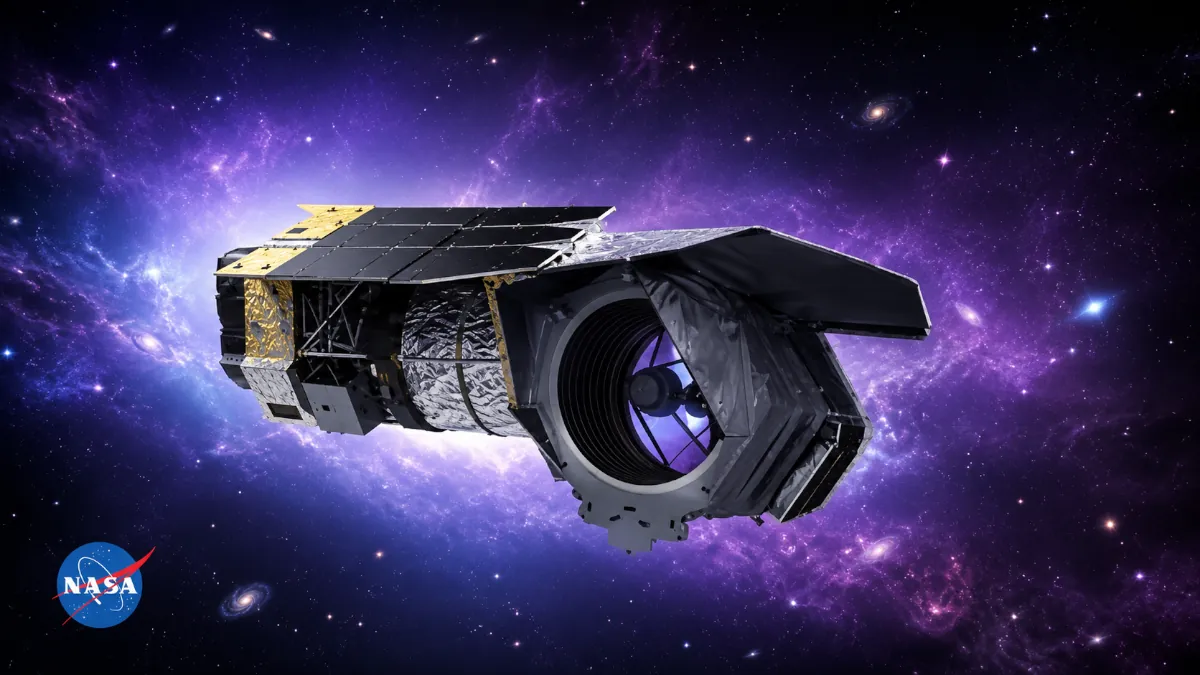
For more than three decades, the Hubble Space Telescope has given us some of the most detailed views of the universe ever captured.
But Hubble has a limitation. Its view is relatively narrow.
NASA's next major space telescope is designed to solve exactly that problem.
The Nancy Grace Roman Space Telescope will have a mirror about the same size as Hubble's — 2.4 meters across — and similarly sharp infrared vision.
But it will see a patch of sky at least 100 times larger in a single observation.
Instead of looking through a cosmic keyhole, Roman will open a window.
Same size mirror, but much bigger picture.
Roman's main instrument is called the Wide Field Instrument, or WFI.
Its camera contains roughly 300 million pixels and is designed to survey enormous regions of the sky while preserving fine detail.
A single Roman image will cover an area of sky about 1.5 times the apparent size of the full Moon. That may not sound enormous until you remember how small Hubble's field of view is. To cover the same region, Hubble would need roughly 100 separate images.
Roman can capture it at once.
That makes the telescope especially useful for studying things that cannot be understood by looking at only one small region of space.
Mapping billions of galaxies
One of Roman's biggest missions will be studying a mystery that affects the entire universe: dark energy.
Observations show that the expansion of the universe is accelerating. We know something is driving that acceleration, but we still don't know exactly what it is.
Roman will survey huge populations of galaxies and exploding stars, allowing astronomers to measure how cosmic structure and expansion have changed over billions of years. Instead of studying a few galaxies in extraordinary detail, Roman can study enormous statistical populations.
Over its mission, the telescope could measure light from around a billion galaxies.
The goal is not simply to see farther. It is to see enough of the universe at once to understand its large-scale patterns.
A planet hunter too
Roman will also search for worlds outside our solar system. One of its techniques is called gravitational microlensing.
When a star passes almost perfectly in front of another distant star, its gravity bends and magnifies the background light. If the foreground star has planets, those planets can produce tiny additional changes in the signal.
Roman will monitor millions of stars toward the center of the Milky Way, looking for exactly these events.
NASA expects its microlensing survey to discover more than 1,000 exoplanets, including planets orbiting far from their stars and possibly even worlds drifting through the galaxy without a star at all.
Roman will also try to hide stars
The telescope carries another instrument with a very different purpose. Its Coronagraph Instrument is a technology demonstration designed to block the overwhelming glare of a star so that much fainter objects nearby can become visible. Such as planets.
Imagine trying to photograph a firefly sitting next to a lighthouse from hundreds of kilometers away. That is roughly the problem astronomers face when attempting to directly image an exoplanet next to its star.
Roman's coronagraph will test technologies that could eventually help future telescopes photograph smaller, more Earth-like worlds.
It is heading to the same neighborhood as Webb
After launch, Roman will travel about 1.5 million kilometers from Earth toward the Sun-Earth Lagrange point known as L2. The James Webb Space Telescope operates in the same general region. From there, Roman will spend years repeatedly scanning large regions of the cosmos.
Webb will remain the specialist for extraordinarily detailed observations of individual targets. Hubble will continue providing its unique view across ultraviolet, visible and infrared wavelengths.
Roman will do something different. It will find the patterns, populations and unusual objects hidden across enormous areas of sky.
Then other telescopes can take a closer look.
A different way of exploring the universe
The history of astronomy is full of telescopes designed to see fainter objects or resolve smaller details. Roman adds another capability:
seeing more at once.
That matters because some of the biggest questions in astronomy aren't about a single star or galaxy. They are about how billions of them behave together.
Hubble taught us how beautiful the universe looks when we zoom in. Roman may show us what we have been missing by not zooming out.



Comments 0
Log in to join the conversation.
Log inStart the conversation.