

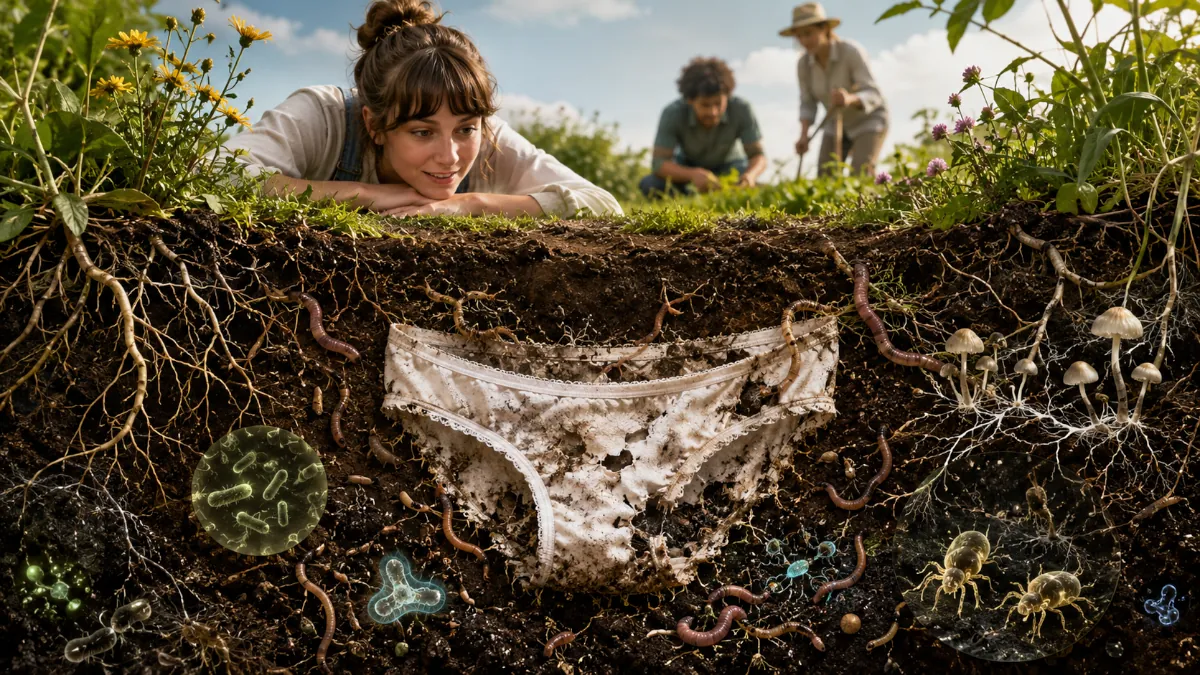
In 2021, around 1,000 people across Switzerland received an unusual scientific assignment.
They were asked to bury cotton underwear in the ground.
Not as a joke, and not as some strange Swiss tradition. The underwear was part of a large citizen-science experiment designed to answer a surprisingly important question:
How alive is the soil beneath our feet?
Soil is much more alive than it looks
A handful of healthy soil can contain enormous communities of bacteria, fungi and other microorganisms, alongside tiny animals and plant roots. Together, these organisms break down dead material, recycle nutrients and help maintain the structure of the soil.
But measuring all of that biological activity across an entire country is difficult. Scientists can collect soil samples and analyze microbes in a laboratory, but doing that at hundreds of locations quickly becomes expensive and complicated.
So researchers from the University of Zurich and Agroscope used something much simpler.
Cotton underwear.
Why underwear?
Most of the fabric in the experiment was made from cotton, and cotton is largely cellulose — an organic material that many soil organisms can break down.
Researchers gave participants two pairs of organic cotton underwear. The volunteers buried them in soil and later dug them back up to see how much fabric remained.
The idea was straightforward:
the faster the cotton disappeared, the more actively the soil organisms were decomposing it.
The synthetic waistband usually survived, which sometimes left behind a rather dramatic result: an almost completely vanished pair of underwear with little more than the elastic still intact.
More than 2,000 pairs went underground
The project, appropriately called “Proof by Underpants,” spread across roughly 1,000 locations in Switzerland.
Participants buried more than 2,000 pairs of underwear and around 12,000 tea bags. The tea bags provided another established way of measuring decomposition, allowing researchers to compare the two methods.
After about one and two months, participants photographed and recovered the underwear. Soil samples and information about the location were also collected for laboratory analysis.
The result was a nationwide picture of how quickly organic material decomposes in different types of soil.
Gardens won. Lawns did not.
The biggest factor affecting decomposition turned out to be how the land was being used.
Private gardens showed the highest biological activity. They also tended to contain more organic carbon and nutrients, providing plenty of resources for organisms living underground.
Lawns showed the lowest decomposition rates, while croplands and grasslands generally fell somewhere in between.
This means two patches of soil that look perfectly normal from above can support very different levels of biological activity underneath.
An underwear index for soil
The researchers developed an underpants decomposition index based on how much of the fabric disappeared.
It is obviously not a complete medical check-up for soil. Soil health depends on many things, including chemistry, structure, water availability, biodiversity and how the land is managed.
But the underwear provides something useful: a cheap and surprisingly intuitive first look at biological activity.
You don't need a microscope to understand that soil capable of eating most of a pair of cotton underwear in two months is doing something.
The experiment also tested citizen science itself
There was another reason to involve so many people.
Soil studies often struggle to collect large amounts of data across wide geographic regions. Citizen scientists made it possible to sample hundreds of sites that a small research team could never have monitored alone.
After filtering the collected data, the researchers were able to analyze 780 locations across Switzerland.
And in an unusual acknowledgment of how important those volunteers were, around 240 citizen scientists were included as co-authors of the published study.
Sometimes simple experiments work
Modern biology increasingly relies on DNA sequencing, satellites, automated sensors and powerful computers.
But sometimes a remarkably simple experiment can still reveal something important.
Healthy soil isn't just dirt. It is an ecosystem filled with organisms constantly consuming, recycling and rebuilding the material around them.
And apparently, one way to watch that ecosystem at work is to give it a pair of underwear and come back two months later.



Comments 0
Log in to join the conversation.
Log inStart the conversation.