

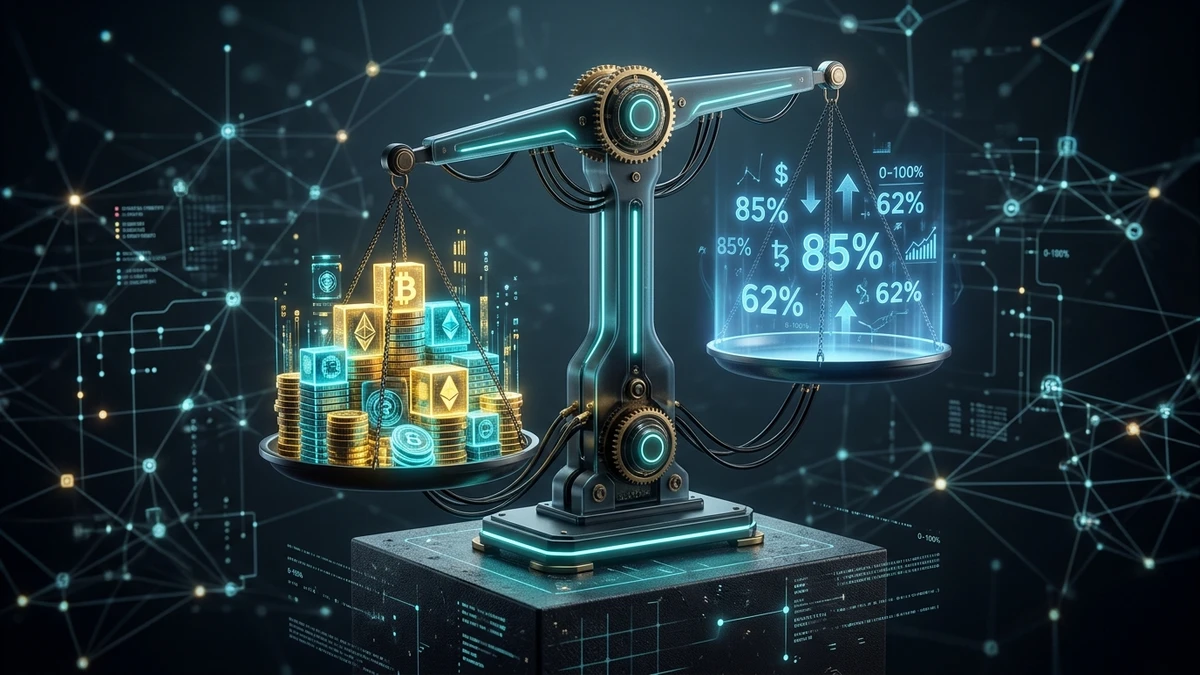
A headline says:
"Prediction markets now give Candidate X a 68% chance of winning."
That number looks strangely authoritative. More precise than a pundit. Faster than a poll. Almost like somebody measured the future and got 68%.
But 68% of what?
Not 68% of traders. Not 68% of dollars ever bet. Not 68% of voters. And not a statistical confidence interval.
It is a market price.
That sounds like a small distinction. It changes almost everything.
The Probability Is a Price
On a binary prediction market, a YES share pays $1 if the event resolves YES and $0 if it resolves NO. A NO share does the opposite. The two sides are created from collateral using conditional-token infrastructure, so one complete YES/NO set ultimately represents one dollar of possible payout [1].
If YES is trading around $0.65, the market is usually described as assigning a 65% probability to YES.
But Polymarket does not calculate that number by asking every trader what they believe. It runs an order book: buyers post prices they are willing to pay, sellers post prices they are willing to accept, and trades happen where those intentions meet.
Even the number displayed on the screen is not necessarily the last price at which anyone traded. Under Polymarket's current rules, the displayed probability is normally the midpoint between the best bid and best ask. If that spread becomes wider than ten cents, the interface shows the last traded price instead [2].
So if the best buyer offers $0.62 and the cheapest seller asks $0.68, the screen may show:
65%You still cannot necessarily buy at $0.65.
You may have to pay $0.68.
That is the first important correction to the "truth engine" story:
the percentage is not a vote. It is a compressed description of an order book.
Money Does Not Vote. It Moves Through Liquidity.
This also changes how we should think about whales.
It is tempting to describe prediction markets as dollar-weighted democracy: somebody with $10 million supposedly gets ten thousand times more influence than somebody with $1,000.
That is not quite how a market works.
Imagine the YES order book looks like this:
SELLERS

$0.69   50 shares
$0.68  100 shares
$0.67  300 shares

BUYERS

$0.64  200 shares
$0.63  500 shares
$0.62  700 shares
A small buyer may take some shares at $0.67 and barely change the market.
A much larger buyer can consume every offer at $0.67, then $0.68, then $0.69. The next available seller may demand $0.72.
The apparent probability rises because the buyer ate through the available liquidity.
They did not cast a bigger vote. They changed the marginal price.
This is why market depth matters so much. A large order in a deep market may do very little. The same order in a thin market can make the screen jump.
The French Whale Did Not "Vote" Trump to 67%
The 2024 US presidential market offered a vivid example.
As Polymarket's election odds moved sharply toward Donald Trump, reporting linked several large pro-Trump accounts to a single French trader known through aliases including Fredi999. The linked positions represented tens of millions of dollars in potential payout [3].
That concentration mattered because one actor was willing to deploy much more capital than most participants.
But there is an important difference between moving a market and manipulating a market.
Polymarket said its investigation found no evidence that the trader was deliberately trying to distort the election odds. He reportedly believed the market was wrong and had a model that gave Trump a higher probability of winning.
And Trump did win.
That makes the case more interesting, not less.
A whale can move the price because liquidity is finite. But if the whale is wrong, the new price can become an invitation for other traders to take the opposite side.
The real question is therefore not:
Can rich people move prediction markets?
Of course they can.
The better question is:
How much capital is waiting to push back when the price moves too far?
A Wrong Price Can Be Profitable
This is the main reason prediction-market prices can contain useful information even though participants have radically unequal amounts of money.
Suppose somebody pushes YES from $0.55 to $0.75, but well-informed traders still think the true chance is closer to 55%.
NO just became much cheaper.
That creates a profit opportunity for anyone confident enough to take the other side. Their trades can drag the price back.
In theory, this is one of the market's self-correcting features: bad prices attract money.
In practice, correction requires somebody to notice the mispricing, trust their own information, have enough capital, have access to the market, and be willing to risk that capital before the event resolves.
Thin markets can fail those tests.
A 2026 analysis of thousands of political prediction markets argued that surprisingly small trades could sometimes produce large movements in displayed probabilities and that some effects persisted. Polymarket and Kalshi disputed the interpretation, arguing that obvious mispricing attracts counter-traders and can correct rapidly [4].
That disagreement is more useful than a simple verdict.
Prediction markets are neither manipulation-proof nor infinitely easy to control.
Their resilience depends on liquidity and the willingness of informed capital to disagree.
Polls Ask People. Markets Ask for Risk.
This is also why prediction markets and opinion polls should not be treated as two competing thermometers measuring exactly the same thing.
A poll might ask:
Who will you vote for?
A prediction market asks something closer to:
At what price are you willing to risk money on who will eventually win?
A person can support Candidate A and still buy Candidate B if they believe B is underpriced. A trader can incorporate turnout, polling errors, future scandals, private research, economic data, or simply a different model of the electorate.
The market therefore does something unusual: it gives participants a financial reason to act on information that contradicts their preferences.
That does not automatically make it more accurate than a poll.
It makes it a different instrument.
Better Information Pays. But Not Every Kind of Information Is Fair Game.
The economics of prediction markets rewards information advantages.
If you discover public evidence that everybody else missed, trading on it can move the price toward a better forecast and earn you money at the same time. This is one reason information markets are attractive in the first place: people have an incentive to search, compare, and disagree.
But the old crypto slogan that "insider trading is a feature" no longer survives contact with the actual market.
In 2026, the US Commodity Futures Trading Commission brought insider-trading cases involving event contracts, including allegations that a Google employee used confidential information about Google's Year in Search results to trade Polymarket contracts [5].
The useful distinction is not public information versus secret information.
It is whether the information was lawfully obtained and lawfully tradable.
Prediction markets can reward superior information without granting a universal license to trade on misappropriated corporate or government secrets.
Then the Future Becomes the Past
So far, everything has been about forecasting.
Traders argue through prices about what will happen.
Then the event happens.
Now a completely different problem appears:
What counts as having happened?
That sounds trivial when the market is:
Will Team A win the match?
It becomes much harder with questions such as:
Will Company X release Model Y before September 30?
Does an API preview count as release? A closed beta? A public waitlist? A downloadable model? What if the announcement happens before midnight but the product becomes available the next morning?
Markets reduce reality to discrete payouts.
Reality does not promise to cooperate.
Someone Still Has to Read the Sentence
Polymarket resolves markets through an UMA-based optimistic oracle process. Every market has resolution rules describing the source, deadline, and relevant edge cases [6].
Once the outcome appears known, someone can propose the answer and post a bond.
Then the system waits.
If nobody challenges the proposal during the two-hour challenge window, it can finalize. If it is disputed, another proposal round can follow. If that second proposal is also challenged, the question can escalate to UMA's Data Verification Mechanism, where UMA token holders review evidence and vote [7].
Most markets do not need the final governance step.
That is why the system is called optimistic: it assumes an answer is acceptable unless somebody is willing to pay to object.
But when a genuinely ambiguous market reaches the dispute layer, the clean binary interface disappears.
The contract still wants:
YES
or
NO
The humans may still be arguing about what the sentence meant.
The Oracle Problem Comes Back
This creates a useful symmetry with the oracle problem elsewhere in crypto.
Before the event, the market asks:
What is likely to happen?
Money answers through price.
After the event, the settlement system asks:
What happened according to these rules?
Evidence, language, and dispute procedures answer that one.
Cryptography can make the trades valid. It can make the payout deterministic after a resolution is chosen.
It cannot make natural language stop being ambiguous.
A prediction market can automate settlement. It cannot automate reality into becoming binary.
And Then the Price Becomes Part of the Story
There is one final complication.
Prediction-market prices are increasingly watched by journalists, political campaigns, investors, and social media. Once a market becomes prominent enough, the forecast stops being merely private information between traders.
It becomes a public signal.
A sudden move from 45% to 70% may generate headlines. Those headlines change expectations. Expectations can change fundraising, trading behavior, media coverage, or the decisions of other participants.
That does not mean Polymarket odds directly determine elections, wars, or corporate decisions.
It means the market can become part of the information environment surrounding the event it is trying to forecast.
trades
  ↓
price
  ↓
attention
  ↓
new beliefs and behavior
  ↓
more trades
The forecast can become one of the things people react to.
An Argument With a Price
Prediction markets can be extraordinarily useful.
They force vague beliefs into prices. They reward people for finding information that others missed. They update continuously instead of waiting for the next survey or analyst note.
But the percentage on the screen is not a sensor reading from the future.
It comes from an order book with finite liquidity, traders with unequal information and capital, and a contract whose language eventually has to map messy reality into a payout.
A prediction market can be useful without being an oracle.
It does not tell us what reality is.
It tells us where money is currently willing to trade on what reality might become.
The percentage looks like an answer. Underneath, it is still an argument with a price.



Comments 0
Log in to join the conversation.
Log inStart the conversation.