

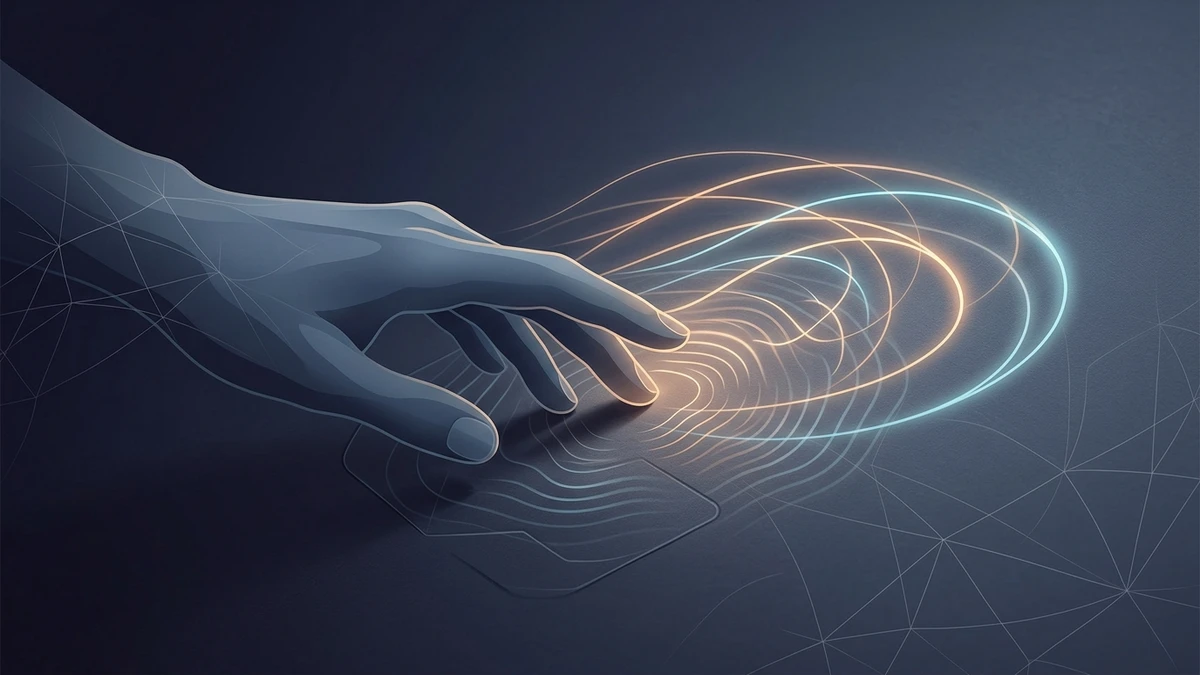
Try tickling your own ribs.
You can feel your fingers moving across the skin. You know exactly where they are touching. But unless you are unusually talented at this, almost nothing happens.
Now let somebody else touch the same spot and the reaction can be completely different. You flinch, laugh, twist away, or grab their hand before they get another chance.
It is tempting to explain this by saying that you simply know your own touch is coming. But that cannot be the whole story. You can know perfectly well that someone else is about to tickle you and still react when they do.
The more interesting difference is that when you produce the movement, your nervous system has information about the action before the touch ever reaches your skin.
Your Brain Knows What Your Hand Is Doing
Whenever you make a voluntary movement, the nervous system generates the motor commands needed to carry it out. At the same time, motor-control theories propose that information derived from those commands can be used internally to predict what the movement is likely to cause[1].
This internal motor information is commonly described as an efference copy.
You can think of it as giving the brain advance notice. If your hand is moving toward your ribs, the nervous system does not have to wait for the skin to report what happened before it begins estimating the likely result.
Forward-model accounts propose that the brain uses this information to predict the sensory consequences of the movement: roughly where the touch should occur, when it should occur, and what kind of sensation it should produce. The cerebellum appears to play an important role in this kind of sensorimotor prediction, although the exact neural machinery is still being worked out.
So by the time your fingers reach your side, the touch is not entirely new information.
Expected Touch Feels Different
This is where sensory attenuation comes in.
When a sensory consequence closely matches what was expected from your own action, the resulting sensation tends to be experienced as less intense than a comparable externally produced sensation.
Brain-imaging studies support this distinction. Self-produced touch has been associated with reduced responses in somatosensory cortex compared with externally produced touch, along with differences in areas including the anterior cingulate cortex[2].
But “attenuation” is important here. The brain does not erase the touch.
You still know that your fingers are pressing against your skin. You can judge where they are and roughly how hard they are pressing. What changes is the strength and salience of the sensation. Your own touch simply does not arrive with the same sensory impact.
Touch produced by somebody else is different. It is not tied to your own motor command, so the nervous system does not have the same action-based prediction available. You may still expect the touch for other reasons—you can see the hand approaching, for example—but that is not the same as predicting the sensory consequences of your own movement.
And there is a beautifully simple way to disturb that prediction.
Make Your Own Touch Slightly Late
Sarah-Jayne Blakemore and colleagues tested this with a mechanical self-touch setup[3].
Participants moved one hand, and that movement controlled a device that produced touch on the other hand. When the movement and the resulting touch lined up closely in time and space, the sensation felt much like ordinary self-touch: relatively weak and not very ticklish.
Then the researchers changed the relationship between action and sensation.
They introduced delays between the participant's movement and the resulting touch, or altered where the touch occurred.
Suddenly, the same basic self-generated action became more ticklish.
The further the sensory consequence drifted from what the movement should have produced, the less effectively it was attenuated[3].
That result is difficult to explain with the simple idea that self-tickling fails because “you know what is coming.” The participant still caused the event. What changed was the match between the action and its sensory consequence.
A delay of only a fraction of a second was enough to make your own touch begin to feel less like your own.
Why Bother Predicting Yourself?
Tickling is a funny example of a much larger problem.
Your body constantly changes the sensory information reaching your brain. You move your eyes. You speak. You walk. You reach for things. Every action produces consequences that could, in principle, be mistaken for events caused by the outside world.
The nervous system therefore benefits from knowing something about what it is about to cause.
If a sensation follows your own movement exactly as expected, that is useful evidence that the event was self-generated. If something happens that your movement did not predict, it deserves more attention.
This distinction also appears to contribute to the sense of agency: the feeling that I am the one causing this action. Sensory attenuation is not the whole explanation for agency, but the match between intended movement and resulting sensation seems to be one of the signals the brain can use.
Clinical research makes this connection especially interesting. In people experiencing symptoms such as passivity experiences—where an action may feel as though it is being controlled by an outside force—the normal distinction between self-produced and externally produced sensory events can be altered[5].
Studies of self-produced touch in these groups have found abnormal attenuation compared with typical participants[4]. That does not mean a failure of tickling explains such experiences. It suggests that the same broader machinery used to predict the consequences of our own movements may also contribute to the normally effortless feeling that our actions belong to us.
Your Fingers Are Too Predictable
So the failure of self-tickling is not really a failure at all.
Your fingers touch the skin, but your nervous system already has a good idea of what that movement is likely to produce. When prediction and sensation line up, the resulting touch is attenuated.
Shift the timing, move the touch somewhere unexpected, or let another person take control, and that prediction becomes less useful. The sensation gains some of its impact back.
Which makes self-tickling a surprisingly neat demonstration of a much broader principle:
Your brain does not only predict the world around you.
It predicts you, too.



Comments 0
Log in to join the conversation.
Log inStart the conversation.